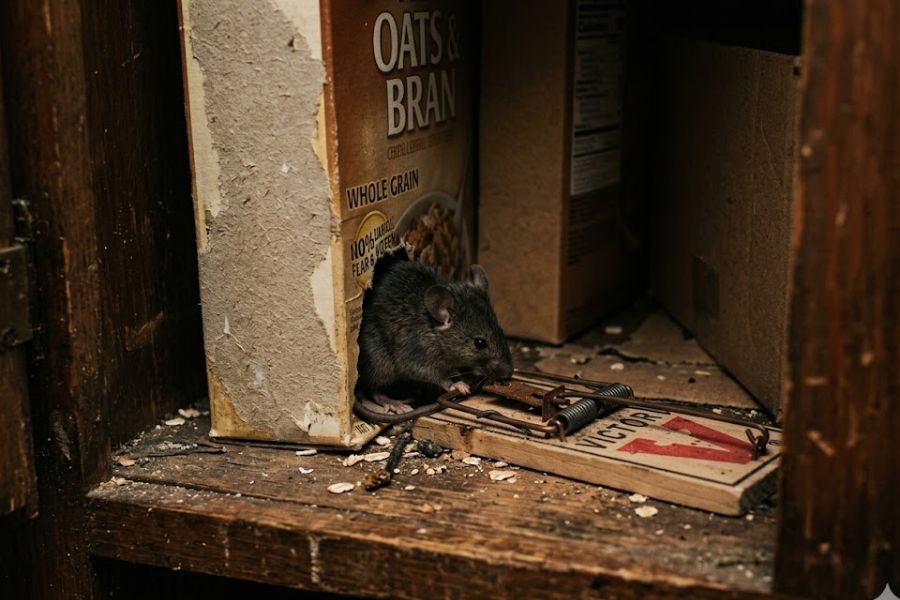
Why Augusta's Mouse Issue Never Gets a Break
House mice (Mus musculus) are year-round residents in Augusta. In cooler climates, outdoor mouse populations shrink in winter, giving owners brief windows of natural reduction. Augusta's humid subtropical climate removes that relief fully. Mice breed indoors in Augusta's air-conditioned summers and heated winters alike. This means a small kitchen mouse issue in September is a well-set up wall-cavity colony by January if left untreated.
House mice fit through any gap a pencil can pass through: 1/4 inch is enough. Most Augusta homes have 15-25 such gaps and the owner has never seen one. We don't treat sightings, we treat structures. Snap traps catch mice you can see; the population behind the walls keeps breeding until the entry points close.
Augusta's housing stock compounds this. The older parts, Harrisburg, Olde Town, Barton Chapel, Bethlehem, have housing that predates recent building standards for gap handling. Doors and windows have settled, outer caulk has failed from decades of heat cycling. Original crawl-space venting was never made with rodent exclusion in mind. Even newer building in Martinez, Evans. Grovetown sees mouse pressure from yard work and attached-garage gaps that Augusta's pest load exploits fast.
The useful consequence: in Augusta, mice do not leave on their own. Snap-trap-only approaches rarely get rid of an in place colony. What works is a combination of colony removal and long-term gap sealing, tackling both the mice show now and the pathways that brought them in.
The ¼-inch rule: An adult house mouse can compress its body through a gap around the size of a pencil, about ¼ inch. This means the gaps around pipe gaps, compressed door sweeps. Degraded foundation caulk that feel trivially small are fully adequate mouse highways. Augusta's heat causes outside seals to degrade faster than in cooler markets, making annual walkthrough of these points mainly worthwhile.
What's Covered in Our Mice Control Work
- Full house inspection, kitchen, pantry, attic, crawl space.
- Colony size and movement-level review
- Entry-point ID and photo records
- Multi-catch trap deployment throughout active zones.
- Snap-trap putting in wall voids and behind appliances.
- Glue-board stations in right sites
- Micro-gap sealing, ¼-inch and larger gaps.
- Door sweep and vent screening suggestions.
- Follow-up confirmation of colony removal
- Sanitation guidance for tainted surfaces
Our Four-Step Mice Control Process
Inspect
Full walkthrough of all areas where house mice nest and travel, kitchen, pantry, attic, crawl space, wall voids, and outer edge.
Review
Colony size estimation from droppings density, grease-trail mapping, and gnaw-mark patterns. Entry-point ID with photos.
Remove
Multi-catch trapping, snap-trap deployment, and targeted bait setup to remove the active colony. Staged over 5-14 days.
Seal
Lasting micro-gap sealing of all confirmed entry points, steel wool, copper mesh, caulk, and expanding foam rated for rodent exclusion.
How House Mice Differ from Rats: Augusta-Exact Comparison
| Factor | House Mouse | Norway / Roof Rat |
|---|---|---|
| Body size | 2.5-4 inches body; 1-2 oz | 6-10 inches body; 7-17 oz |
| Entry-point size | ≥¼ inch (pencil size) | ≥½ inch |
| Where found in Augusta | Kitchens, pantries, wall cavities, any building, any area | Sewers/basements (Norway) or attics (roof rat) |
| Breeding rate | 5-10 litters/year; 5-8 pups per litter | 4-6 litters/year; 6-12 pups per litter |
| Droppings | Rod-shaped, 3-6 mm, scattered widely | Larger capsule-shaped, often clustered near nest |
| Main treatment | Multi-catch traps + micro-gap sealing | Bait stations + exclusion right to species |
Mouse Entry Points in Augusta Homes. What We Look For
Augusta's housing shows set mouse entry challenges. The entry points we most commonly find and seal across Richmond County homes:
Door sweeps and thresholds: Augusta's summer heat causes rubber door sweeps to harden and lose contact with the threshold, creating a gap under every outside door. This is one of the most common mouse entry points we seal, and one of the cheapest to fix.
Pipe holes: Utility lines, plumbing, HVAC, and wiring conduits enter buildings through holes drilled during setup. These holes are rarely sized to the pipe, the around gap is often filled with foam or caulk that in time fails. We probe every open pipe opening with a flashlight during site visit.
Garage-to-living-space transitions: The shared wall between an attached garage and the living area in Augusta homes is often not fully sealed at the top plate, around wiring, or at the service door frame. Mice in the garage use these connections to reach the kitchen.
Foundation-to-siding transitions: Older Richmond County homes with brick veneer or early wood siding often have gaps at the foundation line where the siding matter meets the concrete. These are often not visible without close check at ground level.
Dryer and bathroom vents: Vent terminations on outside walls are a common mouse highway if the screen or flap is missing, damaged, or rusted open. Augusta's humidity accelerates vent hardware wear.
Don't Wait: Rodent Damage Compounds Daily
A small mouse group turns into a large colony within weeks in Augusta's climate. Call now for same-day walkthrough gaps across Richmond County.
📞 Call (844) 635-0403DIY vs. Expert Mouse Control in Augusta
Most Augusta owners who call us have by now tried store-bought traps. Here's an honest review of when DIY works and when it doesn't:
DIY snap traps work when: The infestation is recent (you've seen one or two mice over a few days), entry points are now sealed or the source is plainly a single opening like a recently delivered appliance. The mice are concentrated in one easy to reach area. In these setups, two weeks of aggressive trapping with fresh bait often removes the issue.
Expert control is needed when: You've been trapping for more than two weeks without removing signs. You're hearing scratching in wall voids, mice in walls are inaccessible to standard snap traps. Droppings appear in many rooms or areas of the house. You've had the issue before and it returned. You can't find the entry point. Any of these cases shows an in place colony with many entry points. This needs a home walkthrough to handle comprehensively.
Health Risks of House Mice in Augusta Homes
House mice contaminate food preparation surfaces, stored food, and HVAC ductwork. In Augusta, where humidity promotes rapid bacterial growth, mouse droppings and urine show pathogen risks beyond what you'd see in a drier climate:
- Hantavirus: Transmitted through contact with or inhalation of mouse droppings, urine, or nesting goods. Risk is concentrated during cleanup of infested attics and crawl spaces.
- Salmonella: Spread through mouse droppings contaminating food or food-prep surfaces. A particular concern in kitchen infestations where mice access pantry goods.
- Leptospirosis: Spread through mouse urine, mostly in Augusta's high-humidity area where urine can persist in crawl spaces and wall voids.
- Wiring fire risk: Mice gnaw always, it's a physiological need to prevent incisor overgrowth. In Augusta's older housing stock where wiring may now be aging, gnawed electric insulation is a meaningful fire hazard.
Augusta Areas We Serve for Mouse Control
- Downtown
- Summerville
- Olde Town
- Harrisburg
- West Augusta
- Southside
- Forest Hills
- Highland Park
- Barton Chapel
- Bethlehem
- Martinez
- Federal Hills
- Evans, GA
- Grovetown, GA
- North Augusta, SC
- Aiken, SC
- Hephzibah, GA
- Waynesboro, GA
What Shapes the Quote for Mice Control in Augusta
House mouse jobs are usually smaller than rat work, because mice are easier to trap, easier to seal out. The entry-point work is most often concentrated around the kitchen and pantry rather than spread across the whole frame. But Augusta's older housing stock can drive difficulty fast when the original building allowed dozens of small entry points the homeowner didn't realize existed.
| Work Scope | Standard Use Case |
|---|---|
| Inspection & written figure | You've seen droppings or heard action, want an expert check before committing to treatment |
| Basic mouse trapping (single visit) | Confirmed low-severity movement, entry points now controlled, you want expert trap setup |
| Full mice control (trapping + entry-point sealing) | The standard scope for homes, what makes durable results without recurring work |
| Full control + attic / wall void cleanup | In place colony with droppings soiling beyond the fast kitchen area, common in older Harrisburg and Olde Town homes |
Three factors shape the scope. Home size matters but less than people assume, a 1,200-square-foot bungalow with thirty entry points takes more labor than a 2,800-square-foot newer home with eight. Building era is the bigger shifting: pre-1970 Augusta homes with early sill plates and crawl-space venting carry a lot more sealable area than post-2000 building. Finally, severity at time of call matters, a colony caught in week two of movement resolves faster and cheaper than one that's been growing for six months.
We give written, itemized quotes after the on-site inspection. Flat-rate packages tend to either overcharge simple jobs or under-scope complex ones. We'd rather price each site accurately than offer a tier setup that fits nobody well.
Factors That Change Your Specific Quote
- Number of viable entry points (most Augusta homes have 15-25 pencil-width gaps mice can use)
- Whether active colony removal is needed alongside exclusion sealing
- Accessibility of garage corners, HVAC penetrations, and plumbing chases
- Site size and number of floors (single-story sealing is faster than 2-story)
- Whether snap-trap-based active removal or live exclusion is preferred
About insurance: Standard homeowners insurance generally does not cover routine mouse control. Mice causing electrical-wire damage that leads to a fire or short-circuit failure may qualify for secondary-damage coverage on most HO-3 policies. We document any wire damage we encounter during sealing and provide it to your carrier if relevant.
Want a written quote? Call (844) 635-0403 for a free on-site mouse-control assessment in your specific home.
What Mice Control Looks Like in Other Augusta Areas
The same work plays out unlike that based on where the site sits. In Summerville and the historic core, the work is most often inner-heavy: original cabinetry, plaster wall voids. Steam-radiator chases create dozens of micro-pathways that need careful exclusion. The neighbors of Walton Way and the side streets between 13th and Hickman Road often have mouse pressure that's been steady for years rather than yearly.
In newer Columbia County builds, Martinez, Evans. The Riverwatch belt in Grovetown, mouse pressure tends to concentrate at attached-garage interfaces. Garage door weather-stripping wears out within five to seven years in Augusta's summer heat. The gap created turns into the main entry path. The exclusion work in these homes is faster but more weatherstripping-focused than what we do in older parts.
South Augusta parts near Phinizy Swamp and the Savannah River strip, Hephzibah and the southern edge of Richmond County, see more pressure from outdoor reservoirs of rodent signs. House mice in these areas tend to enter through crawl spaces and HVAC holes rather than door-frame gaps. Our method adjusts so: crawl-space sealing carries more weight in the work plan than for inland homes.
Often Asked Questions. Mice Control in Augusta
How fast do mice multiply in Augusta homes?
House mice can make 5-10 litters per year with 5-8 pups per litter. In Augusta's year-round subtropical climate, indoor groups can double every 3-4 weeks without intervention. A single breeding pair discovered in October can turn a colony of 50-80 mice by February, all within the same frame.
Can I get rid of mice myself?
Snap traps can reduce seen movement temporarily, but DIY rarely removes a established colony. The core problem, the entry points, needs a home walkthrough to locate and right supplies to seal for good. Most Augusta owners who call us have by now tried store-bought traps for several weeks without win.
How do mice get into Augusta homes?
House mice enter through gaps as small as ¼ inch, about a pencil size. Common Augusta entry points cover compressed door sweeps (degraded by summer heat), dryer vents without screening, utility pipe gaps through outside walls, garage door weather-stripping gaps. Foundation-to-siding transitions on older homes.
What does mice control cost in Augusta?
The quote depends on house size, the number of entry points that need sealing, and whether trapping alone is enough. We quote on site after the walkthrough.
Are mice dangerous?
Yes. House mice spread hantavirus, salmonella, and leptospirosis through droppings and urine. They also gnaw on electric wiring, creating fire hazard risk, a real concern in Augusta's older housing stock. HVAC soiling from mice in ductwork can spread pathogens throughout the home.
How long does mouse removal take?
Active trapping often reduces a home mouse count a lot within 5-10 days. Full colony removal combined with micro-gap sealing is most often achieved within 2-3 weeks. We follow up to confirm no ongoing action before closing the job.
Do mice leave on their own in summer?
No, mainly in Augusta. Indoor mouse numbers are stable year-round in our subtropical climate. Mice by now inside a frame have food, water, and harborage, they have no reason to leave. Heat may push outdoor mice to seek cooler setting inside. But it does not drive indoor groups out.
What's the best way to prevent mice?
Lasting gap sealing is the most good prevention, removing entry points before mice find them. Augusta-exact priorities: replace compressed door sweeps, screen dryer vents and crawl-space vents, caulk utility pipe gaps, trim plants touching the frame. Augusta's humidity degrades outer seals faster than standard, making annual check of these points worthwhile.
How do I know if I have mice rather than rats?
Droppings tell you fast. Mouse droppings are 3-6mm long, dark brown, and pointed at the ends, about the size of a long grain of rice. Rat droppings are 12-20mm, capsule-shaped, and noticeably larger. Sound patterns differ too: mice make light, fast scratching in walls and cabinets, often pre-dawn. Rats make heavier scratching, gnawing, and often audible scampering in attics or crawl spaces. If you're unsure, a free walkthrough settles it in under twenty minutes.