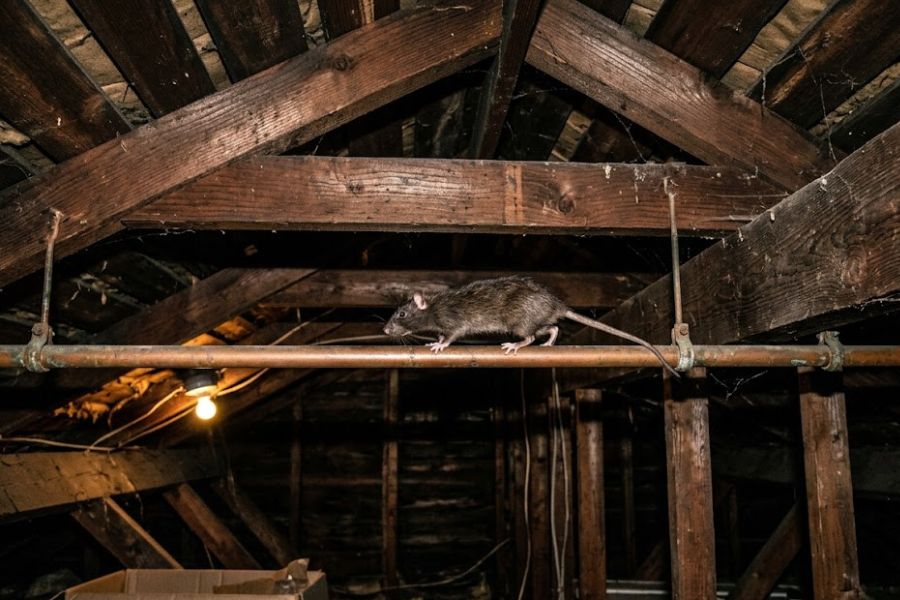
Why Augusta Has a Roof Rat Issue Unlike Most Georgia Cities
Roof rat removal in Augusta, GA is the service that differentiates a rodent pro from a general pest company. Augusta's roof rat issue is a direct product of the city's most beloved feature, its mature live-oak canopy. The same trees that give Summerville, Forest Hills. Highland Park their character create a steady above network connecting the tree canopy to your roofline. Roof rats (Rattus rattus) evolved to exploit exactly this kind of arboreal setting.
Roof rats (Rattus rattus) thrive in mature canopy zones. In Augusta, that means Summerville, Forest Hills, Sand Hills, Lake Aumond, and the older parts of West Augusta where 50+ year-old oak and pecan canopies connect homes via overhead routes. Norway rats stay ground-level; roof rats commute through the canopy from neighbor to neighbor. Treatment needs both the affected home and a canopy-corridor scan.
Roof rats are agile climbers that live at elevation, in trees, in attics, in wall voids above the first floor, and along above utility lines. They rarely come to ground level. This separates them fully from Norway rats, which burrow, and from house mice, which live inside buildings at floor level. A roof rat infestation manifests above: you hear it at night as thumping and rolling in the attic, see it at dusk on fence tops and utility wires. Find its spindle-shaped droppings in attic insulation.
Augusta's concentrated roof rat pressure happens in an identifiable geographic band: the live-oak canopy parts along and north of Walton Way. Summerville, Forest Hills, Highland Park, Lake Aumond. Pepperidge see disproportionate roof rat attic infestations relative to other Augusta parts. The reason is simple, the canopy is denser, older. The branches more likely to contact or overhang rooflines.
Augusta's humid subtropical climate sustains roof rat numbers year-round. Unlike cities north of the fall line where cold winter temperatures suppress rat activity, Augusta's mild winters allow roof rat colonies to breed always. A fall infestation does not self-correct by January, it needs active treatment.
The three-foot rule: If any tree branch comes within three feet of your roofline, roof rats have above reach to your home. This has branches over the chimney, over the garage, and over any addition or porch roof, not just the main roof peak. In Summerville and Forest Hills, the majority of homes fail this test.
Signs You Have Roof Rats in Your Augusta Attic
Roof rat infestations are often diagnosed late because the signs is fully above. These are the signs that should prompt an fast call.
- Thumping and rolling sounds at night: Roof rats are nocturnal and active. Running, rolling nuts, and dragging nesting stuff gives distinctive sounds in attic spaces after 10 PM, louder and heavier than mouse scratching, lighter and more active than raccoon movement.
- Spindle-shaped droppings in attic insulation: Roof rat droppings are 12-16mm long, tapered at both ends (unlike Norway rat droppings, which are blunt-ended), and scattered throughout the attic in active runways.
- Runways in view in blown insulation: Active roof rats compress and flatten paths through blown insulation connecting nesting areas to entry points. These runways are seen on site visit.
- Chewed fascia, soffit, or wiring: Roof rats gnaw through wood fascia and soffit board to create or enlarge entry points. Gnaw marks at roofline level are trait of roof rat movement namely.
- Sightings on utility wires or fence tops at dusk: If you see a rat moving along a fence top or above utility line at dusk, it is almost surely a roof rat. Norway rats don't climb like this.
- Fruit trees with stripped or partially eaten fruit: Roof rats feed on citrus, figs, and other fruiting trees at night. A fig tree with half-eaten fruit scattered on the ground below is a trait sign.
Where Roof Rats Enter Augusta Homes
Roofline exclusion is the most key part of lasting roof rat control, but only if the right entry points are spotted. These are the gaps we find most always during roof rat checks in Richmond County:
| Entry Point | Why It Matters | Treatment |
|---|---|---|
| Soffit vents | Standard aluminum screen mesh is not enough, roof rats chew through it within days | Replace with heavy-gauge hardware cloth or cover with steel exclusion plates |
| Fascia-soffit gap | Settling and wood shrinkage creates gaps where fascia meets soffit, even on homes under 10 years old | Seal with caulk and metal flashing; repair rotted sections |
| Pipe and conduit gaps | Roof deck holes for pipes, wires, and HVAC have gaps between the penetrating object and the wood | Collar with wire mesh; seal gaps with expanding foam + hardware cloth cap |
| Ridge vents | Steady ridge vents with missing or degraded end caps create open access across the whole ridge | Install steel end caps; inspect screen setup |
| Dormer-roof intersections | The junction between a dormer face and the main roof is a common gap area in Augusta's older homes | Inspect for wood decay and gap; seal with flashing and caulk |
| Tree branch overhang | Not an entry point itself but the delivery mechanism, branches within 3 feet give direct reach | Trim to 3-foot clearance minimum; urge to homeowner as companion action |
Our Roof Rat Removal Process
Inspect
Attic inspection for droppings, nests, runways, and entry-point signs. Outer roofline inspection for all gap categories above.
Trap
Snap-trap network deployed along active attic runways. We check and reset every 5-7 days until zero movement for two consecutive visits.
Confirm
Zero ongoing movement confirmed before exclusion. Sealing an active colony in place creates a dead-rodent odor issue that lasts weeks.
Exclude
Lasting sealing of all confirmed roofline entry points. Hardware cloth, steel exclusion plates, caulk, and flashing installed to last.
Roof Rat Removal + Attic Cleanup
Many roof rat infestations in Augusta need attic fix after removal, mainly those that have been active for more than a few weeks. Roof rat activity leaves behind fouled insulation, nesting stuff, urine saturation. Droppings that create ongoing odor and health risk if left in place.
Our attic cleanup service after roof rat removal has: droppings vacuuming with HEPA gear, nest stuff removal and disposal, enzyme-based sanitizing of fouled areas, and insulation state review. If insulation is heavily fouled, we urge new and can do that scope separately. The wiring check that should follow any major attic rodent infestation is a referral to a licensed electrician, we log gnaw damage we see but do not do electric work ourselves.
- Attic inspection and entry-point mapping.
- Snap-trap network deployment at active runways.
- 5-7 day follow-up trap checks
- Movement confirmation before exclusion
- Soffit vent exclusion (hardware cloth swap).
- Fascia-soffit gap sealing
- Pipe and conduit collar install
- Ridge vent end-cap check and repair.
- Written entry-point records and report
- Tree trimming note (done by arborist).
- Attic cleanup and sanitizing (separate scope, quoted on-site).
- Insulation swap (if needed, quoted separately).
Same-Day Inspection + Quote, No Charge
Roof rat attic damage compounds weekly, chewed wiring, saturated insulation, structural gnawing. Call now and we'll confirm same-day availability for your Augusta area.
📞 Call (844) 635-0403Augusta Areas With Highest Roof Rat Pressure
We see concentrated roof rat signs in Augusta's canopy areas. These aren't arbitrary, the live-oak density in each area creates the above reach routes that roof rats need.
Summerville is Augusta's highest-pressure roof rat area. The dense live-oak canopy along Walton Way, Milledge Road, Aumond Road. Berckmans Road creates above reach to nearly every site in the historic district. Homes with mature oaks touching or overhanging the roofline, which is most of Summerville, should be inspected annually.
Forest Hills shares Summerville's canopy character and sees comparable roof rat movement. The mid-100 years housing stock along Forest Hills Drive and Wheeler Road has aging soffit and fascia board that creates entry points faster than newer building.
Highland Park and Lake Aumond have mature home canopy with similar pressure patterns. Lake Aumond homes with tree canopy over the waterfront and the back of the house see bidirectional roof rat pressure, from the canopy and from greenery at the shoreline.
Pepperidge and Federal Hills have comparable canopy density in the Columbia County strip and see roof rat movement steady with Summerville-type parts.
Augusta Areas We Cover for Roof Rat Removal
Linked Services
What Shapes the Quote for Roof Rat Removal in Augusta
Roof rat removal is usually a bigger job than ground-level Norway rat work because attic and roofline access needs more labor and heavier exclusion gear. The roofline gaps themselves, soffit gaps, gable vents, dormer junctions, fascia transitions, need set exclusion supplies that handle weather exposure unlike that than foundation work.
| Service Scope | Notes |
|---|---|
| Attic inspection + roofline review | Has records of all roofline entry points, droppings spot map, and species confirmation. |
| Roof rat trapping (single phase) | Strategic trap setup in attic and along travel routes, multi-visit if needed. |
| Full roof rat removal + roofline exclusion | The standard scope, trapping plus lasting sealing of all roofline holes. Makes durable results. |
| Removal + attic insulation swap | Needed when droppings soiling is major. Insulation costs depend on attic size and new stuff grade. |
Two factors make a roof rat job bigger. First, roof height, two-story homes with steep pitches in Summerville and Forest Hills need more setup time and safety gear than single-story ranch homes. Second, the number of dormers, gables, and roofline difficulty, a simple gable roof seals faster than a multi-dormer Victorian. The labor difference shows up in the quote.
Factors That Change Your Specific Quote
- Roof access difficulty: single-story vs. 2-story vs. complex multi-roof geometry
- Canopy proximity: homes with mature oak or pecan canopy within 8 feet of roofline often need branch trimming alongside sealing
- Number of soffit, ridge-vent, and fascia entry points (typically 4-12 per home in canopy zones)
- Whether nearby properties also show roof-rat activity (cooperative block treatment is more durable)
- Attic cleanup scope after removal: light cleanup vs. full insulation replacement
About insurance: Roof rat removal is out-of-pocket. Roof and soffit damage that caused the entry may qualify for storm-damage or wind-damage coverage. Attic insulation replacement after long-term soiling often qualifies as secondary damage under HO-3 policies. We document the entry conditions and insulation contamination scope separately.
Want a written quote? Call (844) 635-0403 for a free on-site roof-rat assessment and quote.
Roof Rat Removal FAQ. Augusta, GA
Why are roof rats so common in Summerville and Forest Hills?
Augusta's mature live-oak canopy creates a steady above pathway from tree to roofline across these parts. Roof rats are agile climbers that evolved to exploit exactly this kind of arboreal setting. The trees that make Summerville and Forest Hills visually distinctive are the main driver of their above-standard roof rat pressure.
What are signs of roof rats in my Augusta attic?
Thumping or rolling sounds in the attic after dark. Spindle-shaped droppings in attic insulation; compressed runways seen in blown insulation; gnaw marks on fascia or soffit board; and sightings on fence tops or utility lines at dusk. Daytime attic sounds are rare, roof rats are nocturnal.
How do roof rats enter an Augusta attic?
Soffit vents with standard aluminum screen (they chew through it), fascia-soffit gaps from settling, pipe and conduit gaps through the roof deck, ridge vent end caps, and dormer-roof intersections. Tree branches within three feet of the roofline offer the reach route to all of these entry points.
Can I just use snap traps in my attic?
Trapping without roofline exclusion is a temporary fix. New roof rats from next canopy will re-colonize the attic as long as entry points stays open. Useful roof rat removal pairs attic trapping with roofline exclusion, both in sequence.
How much does roof rat removal cost in Augusta?
It depends on how hard the attic is to reach and how much roofline exclusion the house needs. Attic cleanup is a separate scope. Call (844) 635-0403 for a free site visit and written quote.
Will trimming trees prevent roof rats?
Tree trimming to 3-foot clearance removes the main access route but isn't a full answer, roof rats can also use utility lines and fence tops. Tree trimming should be paired with roofline exclusion.
How long does roof rat removal take?
Attic trapping for a standard home infestation takes 2-3 weeks to get rid of the colony. Roofline exclusion is done after confirming zero movement. Full process runs 3-5 weeks from first visit to sealed roofline.
Do you clean up roof rat droppings and nests?
Yes, attic rodent cleanup is a separate service open after removal. It has droppings vacuuming, nest removal, and enzyme-based cleanup. Insulation swap is also on hand if fouling is major.
Are roof rats the same as black rats?
Yes. Roof rat, black rat, and ship rat are all names for Rattus rattus. In Augusta they're often dark gray to black on top, with large ears, a pointed snout. A tail longer than the body, distinguishing features from the heavier-bodied Norway rat.