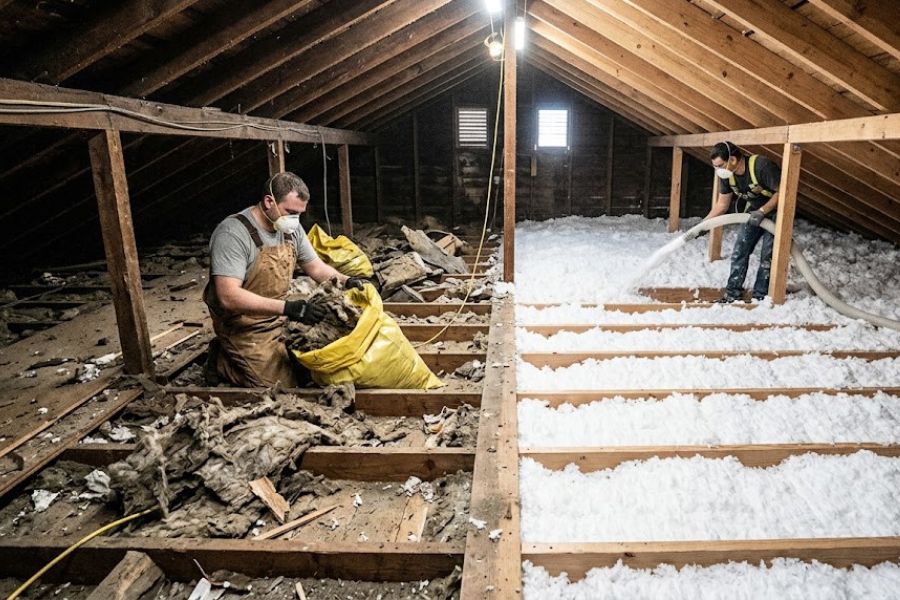
When Insulation Swap Turns into Needed After Rodent Damage
Insulation swap after rodent damage is needed when fouling has spread throughout the attic floor, not just in the areas at once nearby to nesting sites. Rats and mice urinate always as they travel. So a long-in place infestation saturates insulation broadly, not just in the nest pile. The urine breaks down into ammonia compounds that off-gas through the ceiling into living spaces and the active pathogen load stays elevated for months in Augusta's humid, warm attic spot.
Soiled attic insulation isn't just dirty. It's a bacterial and mold reservoir that off-gases into the home through ceiling penetrations and recessed-light cans. Hantavirus, leptospirosis, and salmonella all persist in dried rodent waste. Spot cleanup leaves invisible contamination; full removal-and-replacement is the usual response when soiling is widespread across the insulation.
The useful test for new vs. targeted cleanup is the soiling footprint: if droppings are distributed across more than around one-third of the attic floor area, full insulation removal is almost always the more practical approach than trying targeted removal. Trying to remove single fouled sections of batts or blown insulation often costs more labor than full removal and leaves fouled matter behind.
R-value loss from rodent damage: Beyond soiling, rodents physically degrade insulation. Roof rats compress batts for nesting goods, reducing R-value in nesting areas to near zero. Blown cellulose or fiberglass is tunneled through, creating air channels that bypass insulation fully. Augusta Energy Code needs R-38 minimum for attic insulation, a heavily infested attic can fall a lot below that threshold, increasing cooling costs in Augusta's long, hot summers.
What Insulation Swap Has
- Attic fouling review and scope confirmation.
- Full soiled insulation removal and bagging.
- HEPA vacuuming of exposed attic floor.
- Enzyme cleaner application to decking
- Rodent entry point inspection (exclusion best before re-insulation).
- New blown insulation setup to current code.
- R-value confirmation and records
- Photo records before and after
When Insulation Swap Is Really Needed
Insulation swap is the most expensive part of rodent damage cleanup. It's also the one most likely to be either over-urged (by contractors looking to upsell) or under-urged (by owners trying to save money). The choice should be based on logged fouling extent and measurable R-value loss, not on aesthetic concerns or worst-case-scenario sales pitches.
Swap is plainly must-do when: visible droppings are distributed across the majority of attic floor area. Urine staining is widespread (visible to UV light site visit). Insulation has been mechanically compressed below R-19 by rodent traffic and nesting. Or long rodent activity (6+ months) has happened with no cleanup. In these cases, new is the only path to restored R-value and soiled-free attic setup.
Swap is probably must-do when: moderate soiling is spread across many zones. Nest sites have been found within insulation (not just on top of it). Or soiling cleanup quotes show the cleanup cost approaches new cost. At that point, swap gets you a fresh start rather than a marginally improved existing setup.
Swap is most often not needed when: soiling is localized to a single area (HEPA vacuum + spot cleanup). Rodent activity was brief (under 30 days); insulation is otherwise in good state with current-spec R-value. Cleaning in place often makes the same end result as new for these scenarios at 1/3 the cost.
Augusta-Certain R-Value Needs and Stuff Choices
Augusta sits in Climate Zone 3 per the International Energy Conservation Code. This sets the best attic insulation level at R-38 to R-60. Older Augusta homes often have R-11 to R-19 in original building, a lot under current code. Insulation swap is the native chance to bring R-value up to current standards while doing the work.
| Insulation Type | R-Value per Inch | Best For |
|---|---|---|
| Blown-in fiberglass | R-2.5 | Most standard attic replacements; easy retrofit |
| Blown-in cellulose | R-3.7 | Higher R-value per inch; better for low-clearance attics |
| Spray foam (open cell) | R-3.6 | Air-sealing gain; new building or major renovation |
| Spray foam (closed cell) | R-6.5 | Maximum R per inch; vapor barrier work |
What Shapes the Quote for Insulation Swap After Rodent Damage in Augusta
| Project Scope | Has |
|---|---|
| Partial new (single zone, under 500 sq ft) | Tainted insulation removal, area sanitizing, new to current R-value. |
| Standard home swap (500-1,200 sq ft) | Full attic, blown-in fiberglass or cellulose, thorough sanitizing. |
| Large home or premium stuff swap | Larger attics, spray foam or premium supplies, full sealing work. |
| Whole-attic insulation + air sealing + cleanup | Full thermal upgrade combined with rodent cleanup. Often the right scope for older Olde Town and Harrisburg homes with early R-11 insulation and broad soiling. |
Factors That Change Your Specific Quote
- Attic square footage and current insulation type (blown-in cellulose vs. fiberglass batt vs. spray foam)
- Target R-value (R-30 standard vs. R-49 high-efficiency for Augusta climate zone 8A)
- Whether full removal of contaminated insulation is needed or partial replacement only
- Deck sanitization and any ceiling-side repair (water damage, drywall) following extraction
- Disposal cost for contaminated material (regulated as biohazard in some scopes)
About insurance: Insulation replacement following documented rodent infestation often qualifies as covered secondary damage under HO-3 policies. The carrier typically reimburses material and labor cost when contamination is photo-documented and tied to a removed infestation. We provide adjuster-ready scope documentation as standard.
Want a written quote? Call (844) 635-0403 for a free attic insulation assessment and quote.
Insulation Swap FAQ
Does all the insulation have to be removed?
Only if soiling is widespread. Localized nesting with limited droppings spread may only need partial removal. We review the soiling footprint on-site and give you an honest note, full removal is only urged when it is really the most good approach.
What type of insulation do you install after removal?
We most often install blown fiberglass or blown cellulose, based on the attic building and the homeowner's preference. Both are fitting for Augusta's climate. We install to current Georgia Energy Code minimums (R-38 for most Augusta attics) and can go higher on request.
How much does insulation new cost in Augusta?
The quote depends on the depth and square footage of the attic and on how much insulation has to come out first. We quote after the walkthrough, with removal and new installation scoped separately.
Should exclusion happen before or after re-insulation?
Exclusion must happen before new insulation is installed. Installing new insulation before sealing entry points means the new insulation will simply be fouled again by the next infestation. The correct sequence: removal → cleanup → exclusion sealing → new insulation.
Does insurance cover rodent insulation damage?
Most standard homeowner's policies exclude rodent damage. Some policies cover resulting physical damage (e.g., HVAC damage caused by a rodent-caused setup failure). We give written damage records and scope records for insurance submission, reach ruling is between you and your insurer.
Does insurance cover insulation new after rodent damage?
Standard owners insurance often does not cover rodent damage, like insulation swap. Some policies cover damage from "vermin" only when caused by a covered peril (fire, water damage, storm), pure rodent fouling is excluded. Check your policy language for "infestation" or "vermin" exclusions. Some focus pest-damage riders are open but rare in this market.
Can you tell how much insulation needs to be replaced?
Yes, the check uses visible droppings distribution, UV-light urine staining (visible under ultraviolet walkthrough), insulation density measurements. R-value testing in think areas. We give a written scope showing the certain zones best for new versus cleaning in place. The guess is based on logged soiling, not worst-case assumptions.
Will new insulation prevent future rodent signs?
Insulation itself doesn't prevent rodents, they'll nest in new insulation just as readily as old. Prevention comes from exclusion work that handles entry points before or during insulation swap. Doing swap without exclusion is rebuilding for the next infestation. Combining them makes durable results.
Should I replace with the same insulation type or upgrade?
Swap is the wild chance to upgrade R-value to current code (R-38 to R-60 for Augusta). Sometimes to switch gear (fiberglass to cellulose for better R per inch). An upgrade costs more than a like-for-like swap, and the better insulation value can lower energy use over time. Many Augusta owners choose to upgrade during replacement.
Linked Services
Stop the Damage Before It Spreads. Get a Free Check
Tainted insulation removal and new for Augusta attics. Call to set a damage check across Richmond County.
📞 Call (844) 635-0403