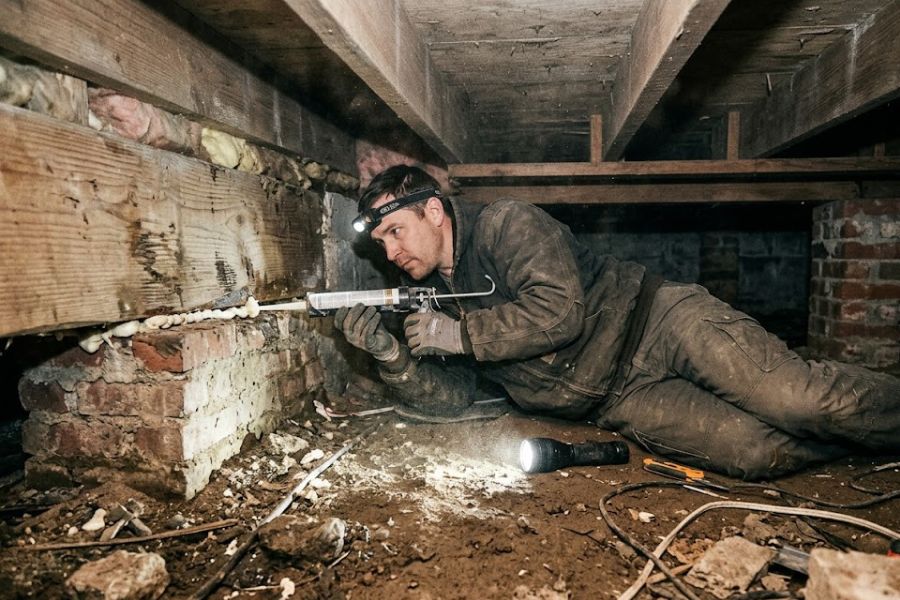
Why Augusta's Crawl Spaces Are the Main Norway Rat Entry Point
Crawl space rodent sealing handles one of Augusta's most persistent structural gaps. The city's older housing stock, concentrated in Harrisburg, Olde Town, Barton Chapel, Bethlehem. Parts of the Southside, was built on brick pier foundations with crawl-space vents that were made for ventilation, not rodent exclusion. Over decades, vent screens corrode, pier gaps open as foundations settle. The below-grade reach points that were never a serious concern in the mid-20th century turn main rodent entry vectors.
Augusta humidity changes crawl-space material choice. Standard galvanized hardware cloth corrodes within 18 months under crawl-space dew points. We use stainless or copper mesh in crawl-space sealing, polyurethane (not silicone) caulk for foundation joints, and we never use expandable foam as the primary seal, because Norway rats chew through it in days.
Norway rats in Augusta are ground-level animals. They burrow, they dig, and they exploit any below-grade opening into a building's foundation zone. For older Augusta homes, the crawl space is where almost every Norway rat infestation originates, not the foundation wall, not the garage. But the vented crawl space underneath the floor setup. Sealing it is the foundational step of any full rat-control program for these homes.
Damp and mold thought: Augusta's humidity creates a dual issue in crawl spaces, rodents seal themselves in alongside the setup that encourage mold growth. If the crawl space site visit reveals signs of damp damage in addition to rodent activity, we will flag it and urge fitting fix before sealing. Sealing a damp crawl space without tackling damp control can accelerate mold growth.
What Crawl Space Rodent Sealing Has
- Full below-grade edge survey
- Foundation vent screen new (hardware cloth).
- Brick pier gap check and sealing.
- Utility opening closure below grade
- Crawl-space access door seal inspection
- Damp setup review (referral if needed).
- Species confirmation (Norway rat vs. house mouse).
- Photo records of all sealed points.
- Written gap map for your records.
Augusta's Historic Areas: Crawl Space Risk Type
Harrisburg and Olde Town are Augusta's highest-risk crawl-space parts, with original brick-pier building dating to the 1880s through 1920s. Foundation settling in these areas is ongoing, and pier gaps that were hairline cracks twenty years ago are now Norway-rat-sized gaps. Homes in these parts that have not had a crawl-space exclusion review in the past five years should be seen as unassessed, no matter of whether an active infestation has been seen.
A Local Team on Call 24/7
Crawl space rodent sealing for Augusta's older homes. We work in Harrisburg, Olde Town, and every Richmond County part with pier-foundation building. Call to set a review.
📞 Call (844) 635-0403Crawl Space Setting in Augusta's Older Housing Stock
Crawl space rodent work in Augusta differs from the same work in colder markets because Augusta's older parts feature housing types. Crawl space setting, that are uncommon elsewhere. Knowing which crawl space configuration your site has helps explain both the scope of work needed and why some homes take twice the labor of others.
Pre-1940 raised-pier crawl spaces in Harrisburg, Olde Town, and the older sections of Summerville feature brick or stone piers with open outside (no steady foundation wall) and ground-level skirt boards that were often unscreened at original building. These crawl spaces need edge screening as their main rodent exclusion, the work is more like building a new structural envelope than sealing isolated gaps. Cost runs proportionally higher.
1940s-1970s block-foundation crawl spaces have steady foundation walls with rectangular ventilation gaps every 8-12 feet of outer edge. First metal vent screens degrade and develop holes. Newer vinyl-frame vents often have gaps around the frame. Entry points concentrate at vent gaps and at HVAC ducting gaps through the foundation wall. Federal Hills, West Augusta, and parts of Hephzibah cluster in this era.
1980s-2000s engineered crawl spaces often cover partial vapor barriers, more standardized ventilation, and improved foundation venting hardware. Entry points are fewer but concentrate at HVAC line-set holes and at the foundation-to-siding band joist. Some homes have been retrofitted with encapsulation (sealed conditioned crawl space) which removes older-style venting but creates varied access points at the sealing terminations.
Encapsulated crawl spaces, increasingly common in newer Augusta building and renovations, feature sealed plastic vapor barriers over the dirt floor, sealed foundation walls, and conditioned air supply. Rodent entry, when it happens, happens at the encapsulation termination points: where the vapor barrier meets the foundation wall, at reach door perimeters. At any utility gaps through the conditioned envelope. The work is meticulous detail work rather than outside-scale sealing.
What Shapes the Quote for Crawl Space Rodent Sealing in Augusta
Crawl space quotes vary more than any other rodent exclusion category because the root building type drives both labor and stuff needs.
| Crawl Space Type | Notes |
|---|---|
| Standard block-foundation crawl space (8-14 vents) | Vent screening new, edge walkthrough, HVAC opening sealing. |
| Pre-1940 raised-pier crawl space | Full outer edge screening, skirt-board repair, structural-grade exclusion. Larger labor footprint. |
| Encapsulated crawl space repair / sealing | Termination repair, vapor-barrier patch, utility opening sealing. Specialized work. |
| Full crawl space + cleanup | Sealing plus removal of fouled insulation, droppings cleanup, cleanup where active infestation happened. |
Two site traits make a crawl space job bigger. First, restricted crawl space reach, clearance below 24 inches creates labor-intensive belly-crawl work. Second, standing damp in the crawl space. Augusta humidity combined with poor drainage on places near the canal or river belt creates setup that need damp control work alongside the rodent sealing.
Factors That Change Your Specific Quote
- Foundation type: brick-pier, concrete-block, slab-with-crawl, or full crawl
- Crawl-space access difficulty and headroom
- Number of foundation vents requiring screen replacement
- Whether vapor barrier replacement is included alongside sealing
- Material choice: stainless or copper mesh required for Augusta humidity (galvanized corrodes within 18 months)
About insurance: Crawl-space sealing is preventive and not covered by standard homeowners insurance. Insulation replacement and vapor-barrier work following a documented infestation may qualify as secondary damage. We document each scope item separately for adjuster review.
Want a written quote? Call (844) 635-0403 for a free crawl-space inspection and sealing quote.
Crawl Space Sealing FAQ
Can I crawl-space seal while rats are still active?
We confirm the infestation is cleared before final sealing. Sealing while active rats stays below the floor creates a dead-rat odor spot as they die inside. The sequence is: inspection, removal treatment, action confirmation, then sealing.
How much does crawl space sealing cost in Augusta?
The quote depends on the number of vent gaps, the extent of the pier gaps, and how hard the crawl space is to reach. Complex or large crawl spaces take longer. We quote after a site visit.
Does crawl space sealing affect ventilation?
We replace corroded vent screens with hardware cloth, keeping ventilation while excluding rodents. We do not seal vents closed. If encapsulation (a sealed vapor barrier setup) is fitting for your crawl space, we will discuss that separately. It is a varied scope from rodent exclusion.
Should crawl space vents stay open or be sealed?
Building codes in Georgia need crawl space ventilation in most non-encapsulated configurations, so vents stay open but screened. Lasting vent closure is part of crawl space encapsulation, another and larger project than rodent sealing. Our work brings vents into rodent-exclusion compliance while keeping the needed airflow.
What about damp and drainage issues in the crawl space?
We spot damp issues during walkthrough but handle them only to the extent they affect rodent work. Standing water and severe humidity issues are foundation or drainage work, not pest control. We often urge a focus contractor for those issues and line up with them to book rodent work after damp is controlled.
Can my crawl space be too short to work in?
Technically no, we work in crawl spaces with as little as 16" clearance, though it's harder and slower. Below 16", the work shifts to whatever can be reached from reach points without full belly-crawl access. Some pre-1940 Augusta homes have crawl spaces this restrictive. We review reach during inspection and price so.
Will crawl space sealing also help with insulation?
Indirectly yes, vent screening with right exclusion gear slightly reduces airflow leakage and the small efficiency loss from rodent-degraded insulation. Major insulation improvement is separate work. If crawl space insulation has been damaged by rodent movement, we remove and replace it as part of full-scope.
Is crawl space sealing other from crawl space encapsulation?
Yes, quite other. Some buildings help from both as sequential projects.
What happens after crawl space sealing, do I need follow-up work?
Most places don't need ongoing work after whole crawl space sealing. A single verification inspection roughly two weeks after completion confirms no missed entry points and that vent screens are seated properly. After that, annual visual check by the homeowner, mainly after severe storms, is most often enough. Homes with chronic setting (next vacant lots, water handling issues) may gain from quarterly upkeep.
Linked Services
whole-home exclusion
Full exclusion program, crawl space plus roofline and utility gaps for whole protection.
preservation-grade exclusion
Exclusion and removal for Augusta's Harrisburg, Olde Town, and Summerville historic places.
rat control
Active Norway rat removal to precede crawl space sealing when an infestation is confirmed.