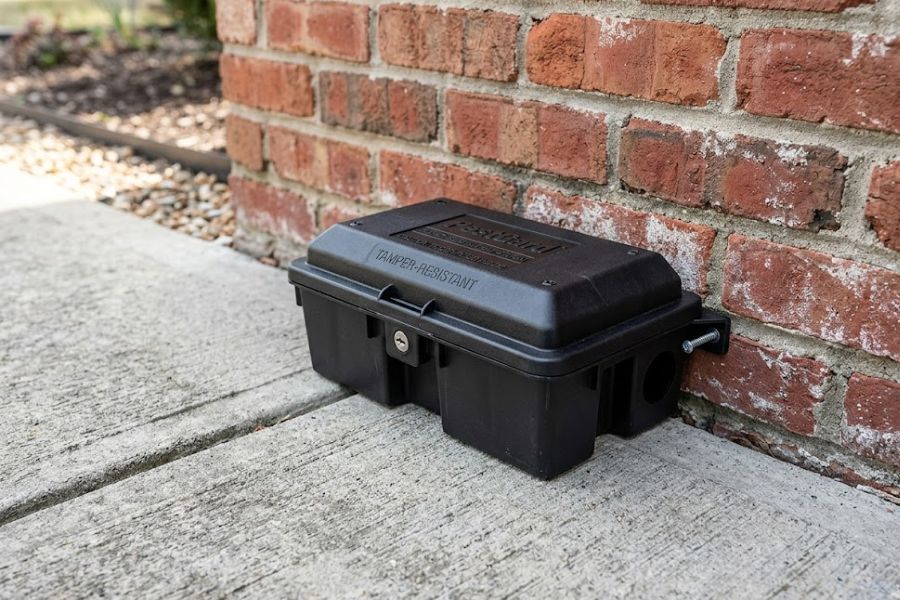
Outside Bait Stations: Augusta's Year-Round Prevention Layer
Rodent bait station setup gives an outer edge interception layer that reduces the rat and mouse count pressure around an Augusta frame before rodents reach the building itself. In Augusta's year-round subtropical climate, where rodent breeding never stops, an outside bait-station program is one of the most cost-good long-term prevention tools on hand for both home and commercial properties.
Bait stations are an outdoor perimeter tool, not an indoor treatment. EPA labels for most rodenticides restrict indoor use to tamper-resistant stations away from food and children. Even then, bait without entry-point sealing just removes the rodents currently dying. Replacement rodents move in within weeks. Bait stations are part of a program, not the program.
Tamper-resistant bait stations are lockable, weather-resistant enclosures that holds rodenticide bait in a configuration that rodents can access but children, pets. Non-target wildlife cannot. They are placed on the exterior outside of the frame, often 15-30 feet apart along the foundation line. Monitored at each refill visit for bait consumption, which shows signs levels. High consumption triggers a walkthrough to find why pressure is elevated.
Bait stations vs. exclusion, which comes first? Bait stations and exclusion serve other works. Exclusion for good seals entry points. Bait stations reduce the numbers of rats that would be trying to enter those points. For maximum effectiveness, exclusion and an outer edge bait program work together, exclusion removes the entry pathways, bait stations reduce the local group that could find new ones. Neither alone is as good as both combined.
What Bait Station Setup Has
- Site outside review and station spacing plan.
- Tamper-resistant station selection (species-matched)
- Anchored outer setup
- Starting bait loading (EPA-listed rodenticide)
- Station putting records and map
- Child and pet safety walk-through
- Tracking card install
- Quarterly or monthly refill and walkthrough program (optional).
Bait Station Setup in Augusta: Site Principles
Useful bait station putting in Augusta follows rat activity patterns, not just home geometry. Stations are placed where rats really travel, along fence lines and foundation walls (rats hug vertical surfaces), near dumpster pads and compost areas (Norway rat attractants), nearby to utility gaps (common entry zones). Near any standing water or drainage network. Stations placed in open lawn areas away from vertical surfaces or attractant sources are largely ineffective no matter of how many are installed.
For Augusta places next to the Savannah River belt, the Augusta Canal, or the downtown restaurant district, we most often suggest higher station density on the exposed faces of the site, those facing the pressure source. Standard spacing on the left outside. This targeted approach makes better results than uniform spacing at half the station count.
What Tamper-Resistant Bait Stations Really Do
Bait stations are misunderstood by both owners (who often think of them as decorative or symbolic) and casual treatment (which sometimes treats them as the whole rodent program). They're neither, they're one tool in an ongoing program. These have certain use cases where they're highly good and other setups where they're the wrong choice fully.
What bait stations do well: Outside edge watching and count suppression at the home edge. Multi-month protection without active intervention. Reducing outer rodent populations that would otherwise migrate indoors during pressure seasons. They're a mainly good fit for business places, multi-family home, and homes with adjacent vacant lots or canal/waterway pressure.
What bait stations don't do well: Resolve active inner infestations (mechanical traps work better for inside work). Address structural rodent entry (that's exclusion). Offer instant resolution (bait works on a 3-7 day timeline after consumption, not same-day). For acute inner cases, bait stations are the wrong tool.
Bait Station Setup and Augusta-Exact Considerations
Useful bait station putting isn't random. Stations work when placed at rodent travel paths, against vertical surfaces (rodents prefer to travel along walls). At fitting intervals around the outer edge. Augusta-area putting also factors in:
- Distance from food work or dumpster. Restaurants and firms with big food waste need denser station range near dumpster areas. Standard home putting is sparser.
- Adjacency to waterways. Homes along the Augusta Canal, near the Savannah River, or on the Phinizy Swamp side of south Richmond County face higher Norway rat pressure that warrants more stations and more frequent upkeep.
- Building outer edge difficulty. Straightforward rectangular buildings need fewer stations per linear foot than buildings with many wings, recessed entries, or complex edge geometry.
- Tree canopy proximity. Homes with mature tree canopy in Summerville, Forest Hills, and Olde Town may need extra roof-line stations for roof rat pressure that ground-level stations don't deal with.
What Shapes the Quote for Bait Station Setup in Augusta
| Setup Scope | Has |
|---|---|
| Starting home setup (4-8 stations) | Site review, station putting, first bait, first 30 days of watching. |
| Starting business setup (10-25 stations) | Larger home setup, often paired with monthly upkeep deal. |
| Monthly follow-up per existing station program | Station inspection, bait new, records. Cost shifts by station count and site difficulty. |
| One-time bait station check + refresh | For existing stations needing inspection and rebait without ongoing plan. |
Factors That Change Your Specific Quote
- Number of stations needed for the outdoor perimeter (typically 4-12 per residential property)
- Bait type and EPA-registered rodenticide chosen for the program
- Service cadence: monthly, quarterly, or seasonal-only refill visits
- Whether commercial scope requires Georgia DPH-compliant tamper-resistant placement
- Documentation requirements for commercial accounts (service logs, bait inventory records)
About insurance: Bait-station programs are operating costs, not insured items. Commercial accounts treat the service as an ordinary business operating cost.
Want a written quote? Call (844) 635-0403 for a free bait-station program quote.
Bait Station FAQ
Are bait stations safe around pets and children?
Tamper-resistant stations are mainly made to prevent reach by children and most pets. The locking mechanism needs a key or tool to open. Stations are anchored in sites along the foundation where people and pets do not most often walk. We walk you through every station place before we leave. The product inside needs many feedings to be lethal to a rat, a dog chewing into a station and reaching a small amount of bait is not most often a medical rush. But call your vet right away if you think pet contact.
How many bait stations does my Augusta site need?
A standard single-family home on a standard Augusta lot (0.25-0.5 acres) often needs 4-8 stations for a good outside program. Business places and lots next to high-pressure zones (canal, river strip, restaurant district) often need more. We review during the site walk and quote so.
How often do bait stations need to be serviced?
Quarterly refill and inspection is the standard for home Augusta places. Business places, mostly those in high-pressure zones, most often need monthly service. We offer both frequencies, and we do not urge quarterly service for business food-work owners.
How much does bait station setup cost in Augusta?
Bait station setup is quoted by station count and how difficult the setup is. Homes usually need a small perimeter program, and business sites are quoted after a site survey.
Do bait stations replace exclusion?
No. Bait stations reduce the local rodent population. Exclusion prevents entry. Both serve other works and work best together. For places where exclusion is not yet whole, bait stations offer meaningful pressure reduction in the interim.
How often do bait stations need to be serviced?
Monthly for business places is standard. Residential properties can sometimes manage on quarterly work based on pressure level. Stations that aren't serviced develop bait wear (Augusta humidity degrades bait faster than drier markets). Stations with consumed bait that isn't replaced lose their suppression effect. Skipping follow-up defeats the goals of having stations at all.
Are bait stations safe around pets and children?
Tamper-resistant stations namely made for this concern. Stations weigh 4-8 pounds, lock with proprietary keys, and have entrance holes sized to admit rodents but not pets or children's hands. Bait inside is secured. Standard setup is also away from high-traffic family areas. The compliance EPA labeling needs this design, if a station is not tamper-resistant, it shouldn't be in home use.
What about secondary poisoning of pets or wildlife?
Newer anticoagulant baits used in proper EPA-compliant programs minimize secondary poisoning risk a lot compared to older formulations. The bigger left concern is consumed rodents being scavenged by wildlife (owls, hawks, opossums) before they decompose. Risk is low but not zero. For places with real raptor numbers, mechanical trapping is sometimes preferred over bait.
How long until I see results from bait stations?
Bait consumption often begins within 3-7 days of station putting. Numbers suppression effects build over 2-4 weeks. Stations are a follow-up and prevention tool, not a rush response, for active infestations needing fast resolution, mechanical trapping inside the frame works on day one while bait stations work the longer outside timeline.
Linked Services
Rodent Control for the CSRA, Since 2023
Tamper-resistant bait station setup for Augusta homes and firms. Call to set an outside check across Richmond County.
📞 Call (844) 635-0403